
How to Check Criminal History in Pierce County
Begin with the kind of event, not a broad name search. A filed Pierce County felony belongs in LINX and the Superior Court clerk's file. A current jail stay belongs in the LINX roster. District and municipal matters use the state court-date tools and the court that heard the case. Police narratives remain with the arresting agency or its records partner. WATCH is useful when the goal is Washington's public statewide conviction response.
Gather the full name, likely spelling, date range, and any cause or incident number. A date of birth helps distinguish common names in an official repository search. Then compare the filing date, court, agency, and charge. Those details reduce false matches.
- Choose LINX, a court, a police records office, or WATCH based on the record sought.
- Search a cause number or enter the name in the format the official form requests.
- Compare court, filing date, and agency before treating a result as a match.
- Open the docket or roster entry, then request the source report or filed document.
- Order a certified copy or fingerprint review when an authoritative self-check is needed.
These routes answer different questions. A searcher should keep the results separate until names, dates, and case numbers line up.
LINX Opens Pierce County Records
Pierce County's LINX search is the local window for Superior Court cases, District Court fields, calendars, and the current jail roster. Cause numbers may be entered with or without dashes. Name searches use last name followed by first name. The form also permits a year range and case-type choice, which can narrow a busy result list.
| Search field | How it works | Best use |
|---|---|---|
| Cause Number | Dashes are optional | Known Pierce court file |
| Name | Last name, first name | Finding possible matches |
| Year Through | Start and end years | Narrowing a long history |
| Case Type | Superior or District choices | Separating criminal from civil results |
| Jail Name | Current inmates only | Checking present custody |
The official Washington case-search image in the Washington Courts access page shows why court level matters.
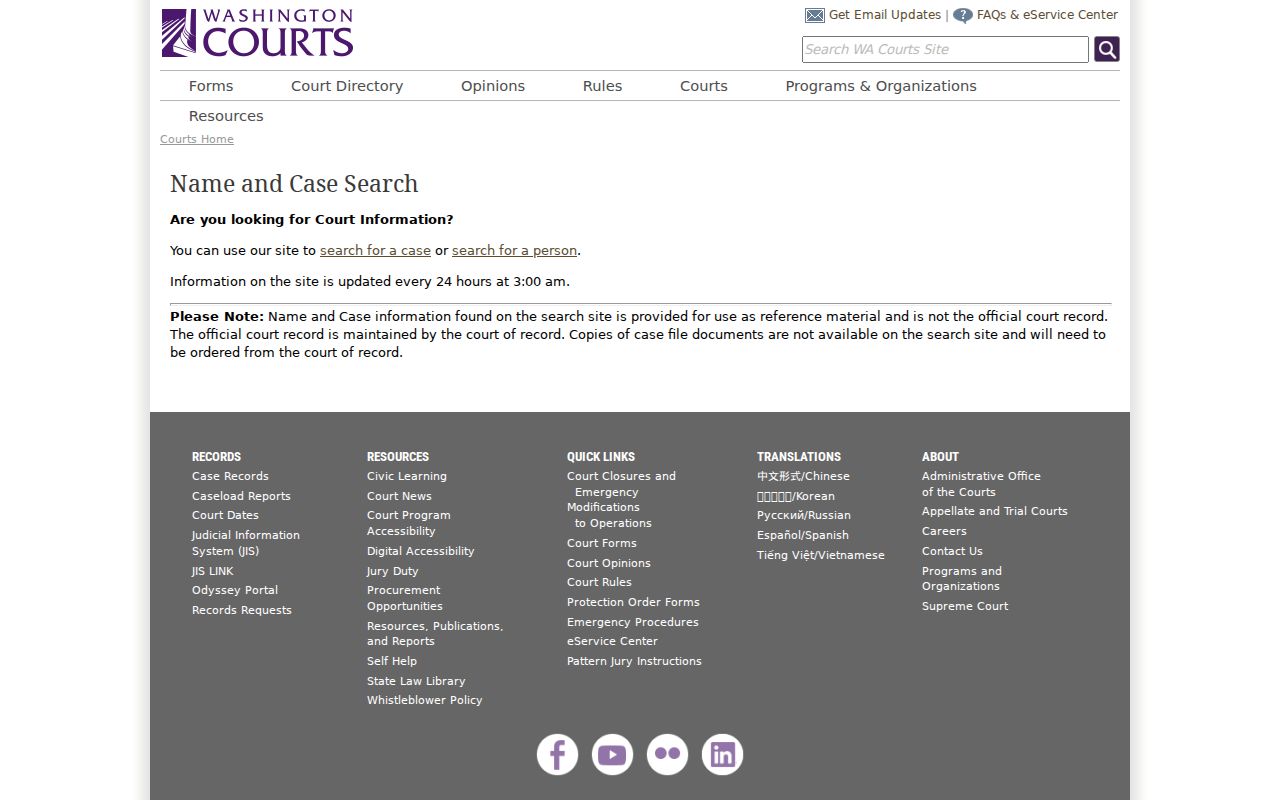
Pierce Superior Court is excluded from Odyssey, so LINX is the right local route rather than a mere alternate search.
Online access also has a date boundary. LINX offers public document images filed after January 1, 2002 for purchase. Older public material can require a scan request or help from the Clerk's records counter, and records before 1991 may require a direct clerk inquiry. A certified court copy costs $5 for the first page and $1 for each added page. Noncertified copies are $0.50 per page in person or by mail and $0.25 per page through LINX. The docket can identify the useful filing before a requester pays for pages.
Official Washington Background Checks
The Washington State Patrol keeps the Washington State Identification System. Its public product, WATCH, searches a name and date of birth. The response includes Washington conviction information, recent arrests still waiting for disposition within the statutory window, and reported sex or kidnapping offender registration data. It is not a person's complete rap sheet, and a name match is not as precise as a fingerprint match.
For personal review, a fingerprint-based WSP request gives the subject a stronger identity match and a path to challenge errors. The FBI also provides a subject-only federal Identity History Summary, but that does not replace Pierce County court documents.
| Official product | Published fee | What it answers |
|---|---|---|
| WATCH name search | $11 each | Public Washington statutory response |
| Online notarized result | $15 extra | Notarized WATCH response |
| Mailed name and DOB request | $32 | Mail-based WSP response |
| Fingerprint record review | $58 | Subject's fingerprint-based review |
| WSP Olympia fingerprinting | $16 | Fingerprint capture; local fees vary |
The WATCH entry screen is the official starting point for the public name search.
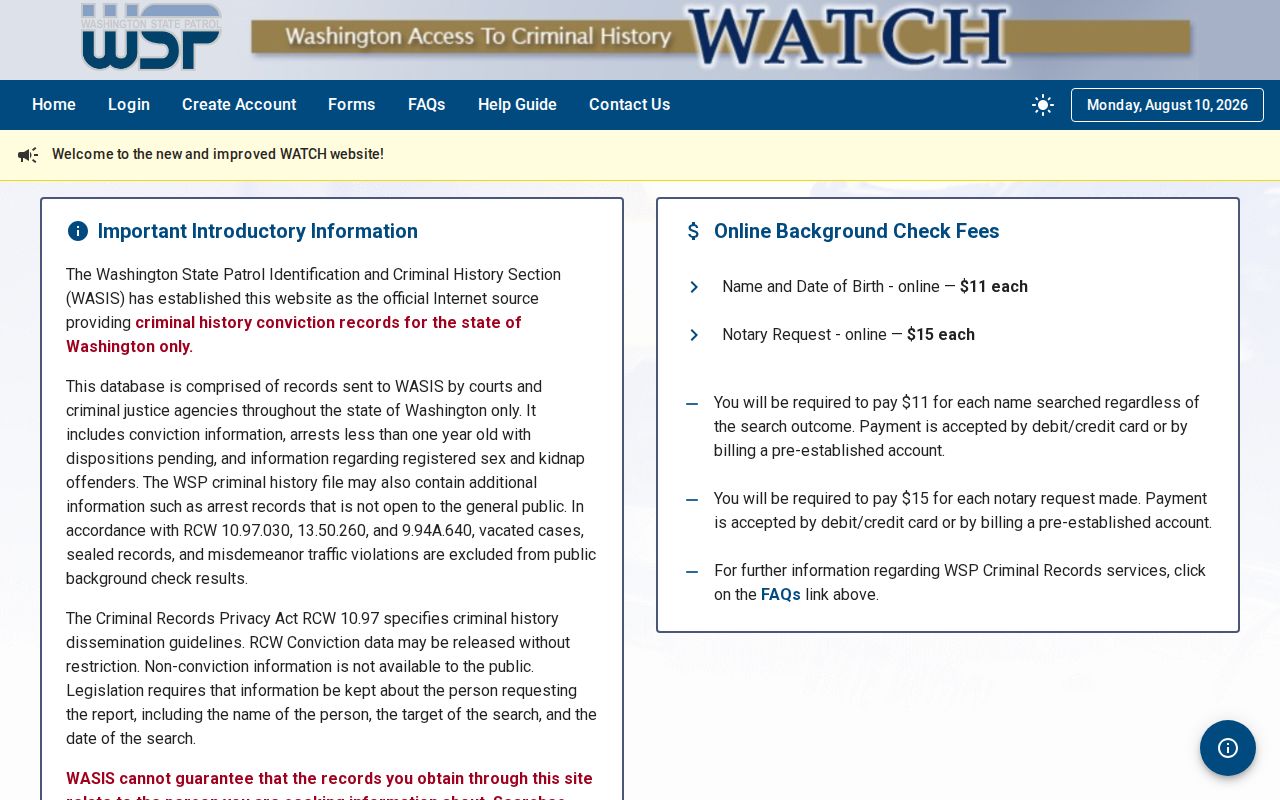
Payment is charged for each name searched, even when no result appears.
WATCH Versus LINX Records
WATCH and LINX can both show criminal record information, but their scope is not the same. LINX centers on Pierce County court events, filed documents, calendars, and live jail links. WATCH is a state repository response built from data sent by criminal justice agencies. A dismissal may be clear in a Pierce docket while a reporting update is still moving through the state system.
Use LINX to follow charges, counsel, hearings, judgment, and local custody. Use WATCH for the public statewide repository view. When the two disagree, compare the cause number and obtain the disposition from the court that entered it. Then use WSP's review and challenge process if the repository entry remains wrong.
The WSP criminal history guidance explains both name and fingerprint channels.
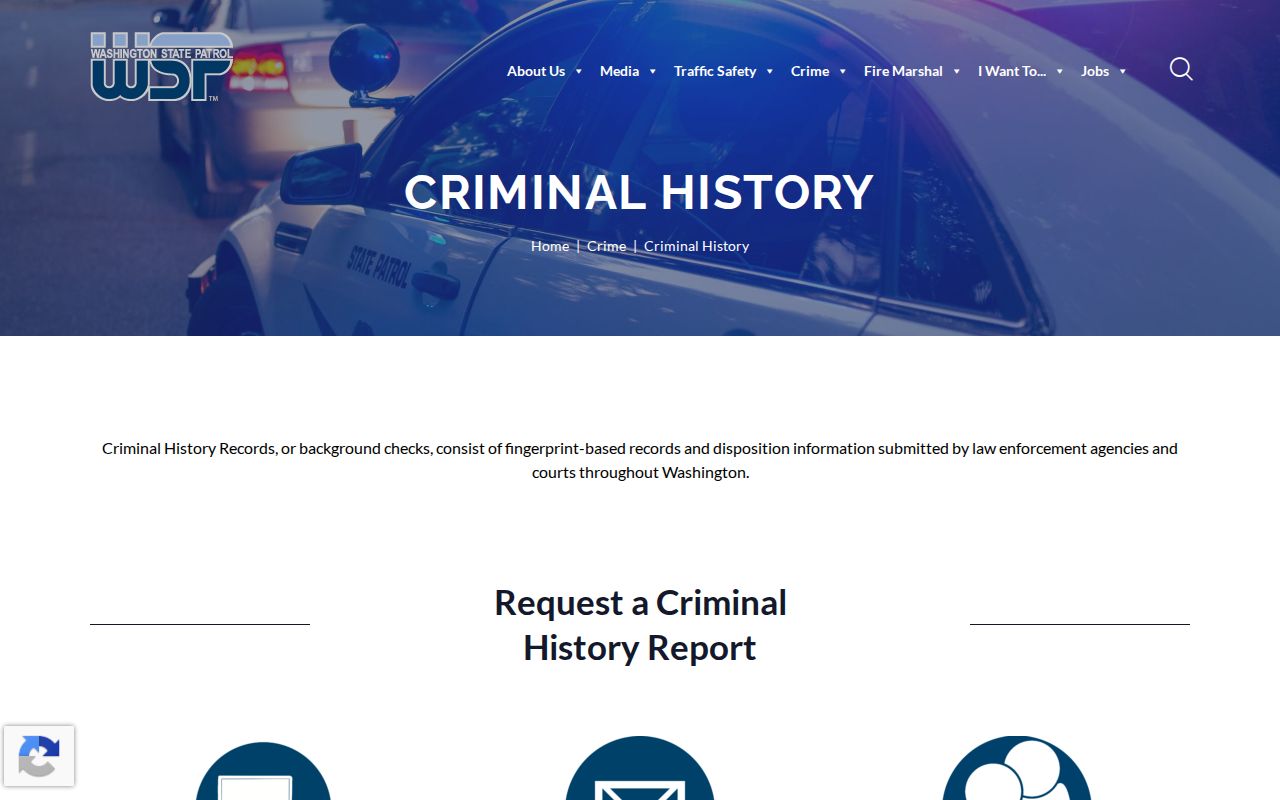
That distinction helps a person choose the record source that can actually correct the disputed field.
Types of Criminal Records
Pierce County criminal records begin in several offices. The first document may be an incident report, but later files track custody, charges, hearings, and final outcomes. One portal rarely carries every layer.
- Incident and arrest report: the sheriff, police department, or regional records office keeps the event narrative.
- Booking record: Pierce Corrections creates custody fields after jail admission, while public access remains limited by law.
- Court case file: the clerk keeps the docket, filed charge, motions, judgment, and sentence.
- Repository history: WSP links reported arrest cycles and dispositions, while WATCH shows only the public subset.
- Supervision or registry record: DOC and local law enforcement hold their own authorized information.
A warrant is its own court and law enforcement record. Its status should be confirmed with the issuing court rather than inferred from an old docket line.
Pierce County Jail Record Gaps
The LINX roster reports current inmates. A person can disappear after release or transfer, so an empty search does not prove that an arrest never occurred. Pierce's open booking dataset covers Corrections admissions since January 2010, yet it should be read as booking data. Repeat admissions are not unique people, and no booking count is a conviction count.
Pierce County has a Main Jail beside the downtown court complex and a New Jail on Nollmeyer Lane. Planning records distinguish designed capacity from staffing-funded beds. The two figures should not be merged into one claim. Most jail records, including booking photos, are confidential under state law. A third party generally needs the inmate's signed authorization or a court order for the restricted file.
The Washington DOC Incarcerated Search is a separate option after a state-prison transfer.
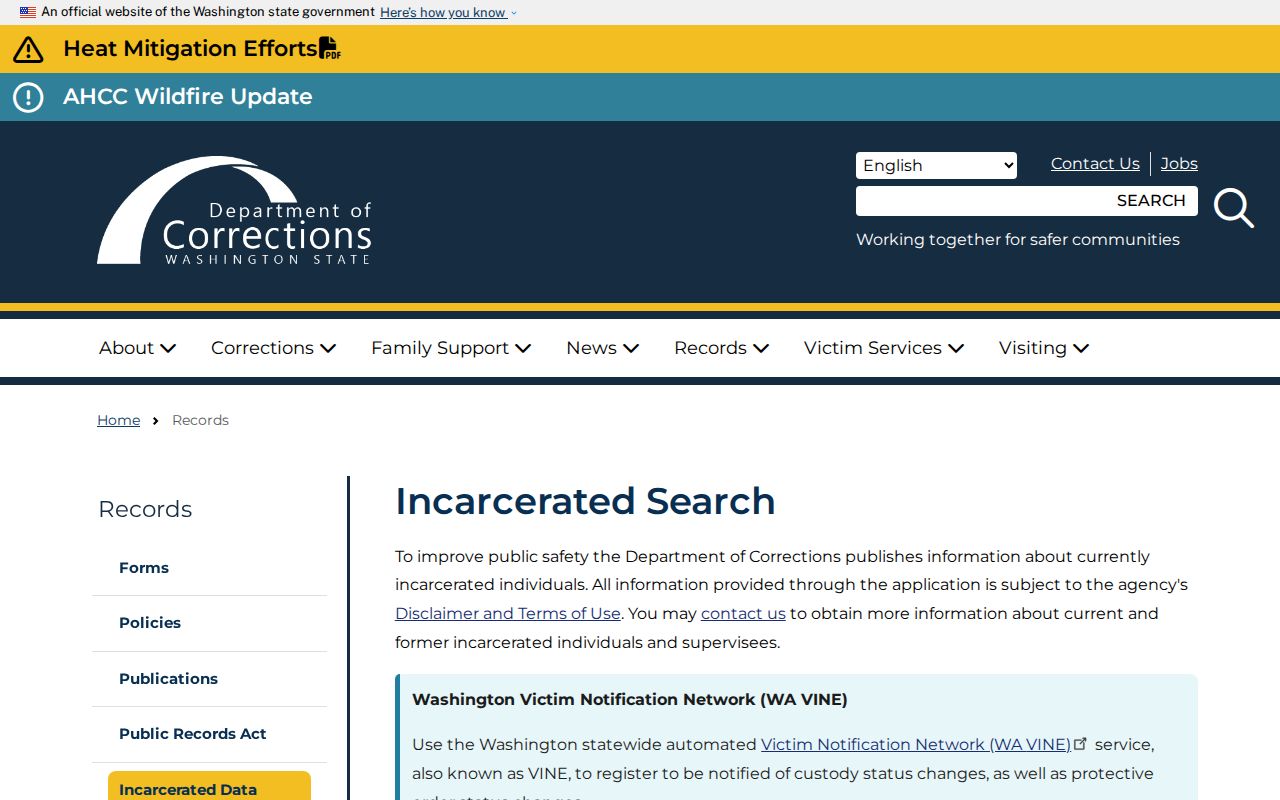
County jail custody, state prison custody, and community supervision are separate record layers.
Note: A current roster entry shows custody and recorded allegations, not guilt or the final filed charge.
What a Pierce County Criminal Record Shows
The fields depend on the holder. A WSP repository cycle follows identity and fingerprint-linked events. LINX follows the court cause. The public jail roster follows booking and custody. Read the source label before drawing a conclusion.
| Name & Identifiers | Name, aliases, birth data, and repository identifiers where authorized. |
|---|---|
| Arrest / Booking Data | Event date, contributing agency, booking date, and public custody fields. |
| Charges & Statutes | Alleged arrest charges or later court-filed counts, which can differ. |
| Disposition | Dismissal, acquittal, plea, conviction, or another recorded outcome. |
| Sentence | Confinement, fine, restitution, or supervision ordered by the court. |
| Custody / Supervision | Jail or DOC status where the holder is authorized to publish it. |
A docket is the time-ordered register of a case. A disposition is the case outcome. Vacation is a later statutory court action, not proof that every historic agency record vanished.
Pierce County Arrest Records Flow
A Pierce County arrest can create four distinct records. The arresting officer starts an agency report. Corrections adds a booking file if the person enters jail. The prosecutor decides which charge, if any, to file. The court then creates a docket, and reportable data can move to WSP.
Incident report → Booking record → Prosecutor review → Court case → WSP disposition update
Each step can change the wording. Probable-cause allegations may be amended before filing. A booking charge may not match the information filed by the prosecutor. The later judgment is the best source for the final court outcome. For deeper custody routing, the dedicated Pierce County arrest history explains the roster and records-request paths.
The Pierce County Sheriff's Office is the public source for sheriff services and records routing.
City police files still go to the city or its official regional records channel, not automatically to the sheriff.
Public Access Laws
Washington uses different access rules for agency files, court records, repository histories, and jail material. The holder decides which law or court rule applies. A narrow request with an incident number, date, location, and named record is easier to review than a vague demand for everything.
Key access rules:
Chapter 42.56 RCW opens agency records subject to exemptions and sets the five-business-day acknowledgment rule.
Chapter 10.97 RCW limits public dissemination of nonconviction criminal history data.
General Rule 31 governs public access to court case records rather than the county public-records portal.
RCW 70.48.100 makes most jail files confidential while defining a narrow public booking subset.
Redactions can protect victims, minors, health information, active investigations, and personal identifiers. The agency should identify the legal basis for withheld material.
Pierce County Criminal Records Offices
Downtown Tacoma concentrates many justice offices, but their counters are not interchangeable. The Superior Court clerk supplies filed case documents. District Court supplies its own files. The Sheriff's Public Disclosure Unit handles sheriff reports and authorized jail material.
Superior Court Clerk
930 Tacoma Avenue South, Room 110
Tacoma, WA 98402
253-798-7455
Pierce District Court
930 Tacoma Avenue South
Tacoma, WA 98402
253-798-7487
Sheriff Disclosure Unit
3602 Pacific Avenue South, #100
Tacoma, WA 98418
253-798-7530
Sheriff requests may be submitted through the county's online channel or by email. The description should identify the incident number when known, a tight date range, the location, involved parties, and the exact item sought. Washington's Public Records Act requires an initial response within five business days, but that response can provide an estimate, request clarification, produce records, or cite authority for a denial. It does not promise final production in five days.
Published county copy charges include $0.15 per printed page, $0.10 per page to scan paper into electronic form, and $0.10 per gigabyte for electronic production. Media and postage can add actual costs. Payment comes before release, and an unclaimed or unpaid request may be treated as abandoned after thirty days. Court-copy charges are different because court files use clerk procedures and General Rule 31. Courthouse visitors pass through security, so confirm closures and counter availability before making the trip.
Sealed, Expunged & Restricted
Washington calls the main adult conviction remedy vacation. Eligible felony requests proceed under RCW 9.94A.640, while misdemeanors and gross misdemeanors use RCW 9.96.060. The court that entered judgment handles the request. A person needs the cause number, judgment, correct state forms, and proof that all statutory conditions are met.
Vacation is not universal deletion. A procedural trail can remain, and some agencies retain authorized access. Separate laws address deletion of qualifying nonconviction data and sealing of juvenile records. Victim names, health details, active investigative facts, and confidential jail records can also be hidden or redacted without the whole case being sealed.
After an order, obtain certified copies and verify that both the court and WSP have updated their records. The originating clerk must correct its own source document before WSP can reliably change a reported disposition.
Pierce County Warrants Need Courts
No complete public countywide warrant database was verified. A Superior Court warrant may appear in LINX. District and municipal bench warrants require the state court tools and contact with the exact issuing court. Law enforcement may confirm operational status but can withhold details that would impede service.
If a warrant appears on a personal record, note the issuing court and cause number. Ask that court about its quash calendar or surrender directions, seek legal advice where appropriate, and follow the court's instructions. Do not approach a wanted person or rely on an unsolicited caller who demands payment. An old docket line is not a safe substitute for current confirmation.
- Arrest warrant
- A court order based on probable cause.
- Bench warrant
- A court-issued order often tied to nonappearance or noncompliance.
- Quashed warrant
- A warrant the court has formally canceled.
- Search warrant
- Authority directed at a place, property, or evidence, often sealed before execution.
Criminal Records by City in Pierce County
Tacoma, Lakewood, and Puyallup are Pierce County's three largest incorporated cities in the official 2025 state estimates. Each has its own police records path and municipal court. A city case may not appear in a Superior Court name search, and an incident narrative stays with the agency that made the report.
Tacoma Criminal History
228,400 residents · South Sound 911 and Tacoma Municipal Court routes
Lakewood Criminal History
64,670 residents · Lakewood Police and a three-city municipal court
Puyallup Criminal History
43,730 residents · City police, court, and a distinct city jail
For each city, confirm the agency, court level, and custody site before ordering a record.
Pierce Criminal Records Need Context
Pierce County's named therapeutic courts can add docket events that make little sense without program context. Superior Court runs Felony Drug Court, Family Recovery Court, Felony Mental Health Court, and Assisted Outpatient Behavioral Health Treatment Court. District Court operates DART, Mental Health Court, and Veterans Treatment Court.
The county reports that Felony Drug Court began in 1994 and has more than 2,700 graduates. It uses a minimum twelve-month model for eligible nonviolent felony defendants. DART began in 2016. Program entry, review hearings, sanctions, graduation, or termination can all appear in a case record. Those events do not replace the judgment, but they explain why a case may have a longer or less familiar docket path.
Juvenile diversion creates a different access gap. Pierce County notes that diversion is confidential, while formal juvenile court processing can be public subject to juvenile-record rules.