
Running a Sex Offender Check in Pierce County
The Washington Sex Offender Public Registry is the main public search for Pierce County. The Washington Association of Sheriffs and Police Chiefs presents information supplied through local law enforcement. The Pierce County Sheriff's Sex Offender Information page explains the local registration and community-notification role. Use the state search first for a name or place, then contact the sheriff when a Pierce County address seems wrong or a compliance question cannot be answered by the public entry.
The public registry is one part of the record system. It is not a full criminal case file, a jail roster, or a Washington State Patrol rap sheet. A result may show only the detail that the law permits for that risk level. No result can prove that a person has no qualifying history, since public visibility and registration duties are not identical. Match more than a name before relying on an entry.
Pierce County Registry Verification
Local law enforcement handles registration and address verification while the statewide site publishes the information authorized for release. In Pierce County, that makes the sheriff's information page the practical second stop after the registry. It explains local notification work and gives the agency route for a question about a Pierce County registrant. A suspected stale address should be reported, not tested through a visit or confrontation.
The official Pierce County Sheriff WA app launched in 2024 and advertises sex-offender search links, public-safety alerts, the inmate roster, and report resources. It is a shortcut to official services, not proof of a separate registry database. Website and app results ultimately depend on records maintained by the responsible agency. For an emergency, call 911. For a nonurgent compliance concern, use the published sheriff channel and provide the location and facts without posting private accusations online.
The 2024 launch matters because Pierce County residents can reach registry resources and alerts from one official mobile entry point. Still, the Pierce County app should be read as navigation. A linked public profile comes from the registry system, and a Pierce County compliance inquiry belongs with local law enforcement. This split keeps a safety search tied to the record holder. It also prevents an app notice from being treated as a court judgment or a complete criminal history.
Searching the Washington Sex Offender Public Registry
The official interface requires acceptance of its terms before a Pierce County sex offender search. Automated inspection could not confirm every live control because the registry blocked that access, so exact button labels, radius choices, and result limits should be checked in the current interface. The confirmed search categories support a careful four-part process:
- Open the official registry and accept its lawful-use terms.
- Search by name, then try the address, city, ZIP, or Pierce County geographic category when relevant.
- Review any map or list that the live interface provides and compare available identifiers before opening a result.
- Read the profile as a public-notification record, then verify a location or compliance concern with Pierce County law enforcement.
The search fields below reflect only categories confirmed in the research. An unspecified control is marked that way rather than guessed.
| Field or Control | Type | Required | Notes |
|---|---|---|---|
| Terms acknowledgement | Checkbox or button | Yes | Accept the lawful-use warning before searching |
| Name | Search category | Unspecified | First and last name category |
| Address, city, or ZIP | Geographic category | Unspecified | Use for a place-based Pierce County check |
| County | Search category | Unspecified | The official portal supports Pierce-scoped searching |
| Radius, map, and results | Live controls | Unknown | Confirm current choices in the registry interface |
Pierce County Level I Records
Washington bases public notification on assessed risk and the need for public protection. Level I information generally receives limited disclosure rather than broad address-based publication, unless a statute permits more. Schools and other specified organizations may receive notice in defined circumstances even when the public website shows little. That difference explains why a Pierce County name search can be blank or spare without answering every question about registration status.
Level II and Level III classifications permit broader community notice. The higher level supports wider release, but a risk label is not a verdict about current conduct and should not replace the details in the official profile. Searchers should also avoid treating a sparse Level I entry as an error. The disclosure rules deliberately vary. Pierce County law enforcement remains the source for a lawful follow-up when the public view does not resolve an address concern.
What a Registry Profile Shows
A public profile can contain identifying and registration fields, but the exact set varies with risk and legal authority. Because no private registrant was used as a research sample, the inventory below describes field categories to check on the live record. It does not claim that each Pierce County profile displays every category. Absence from a public page also does not mean the sheriff lacks the data.
| Name & Aliases | Public identifying names when authorized; compare carefully because names alone can match more than one person. |
|---|---|
| Photo & Description | A photograph, physical traits, marks, or tattoos may appear when the profile and law permit them. |
| Address or Location | The registered address, approximate location, or another authorized location description may be shown. |
| Offense Details | An offense, statute, or date may appear, but the registry does not reproduce the full Pierce County court file. |
| Risk or Status | A Washington risk level or registration status may be presented according to public-notification rules. |
| Agency Information | The registering or verifying agency may be identified so a concern can reach the correct office. |
For charges, motions, disposition, and sentence, consult the court record rather than reading those details into a registry entry. Pierce County Superior Court cases use LINX, while municipal matters remain with the city court.
Pierce County Registry Searches Beyond Washington
The Department of Justice National Sex Offender Public Website adds a cross-state layer when a person or address may connect to another jurisdiction. It searches participating public registries, then points back to the contributing state, territory, or tribal source. NSOPW is useful for movement across Washington borders, but it does not replace Pierce County verification or turn different state disclosure rules into one uniform record.
The official national search interface is shown in the NSOPW source.
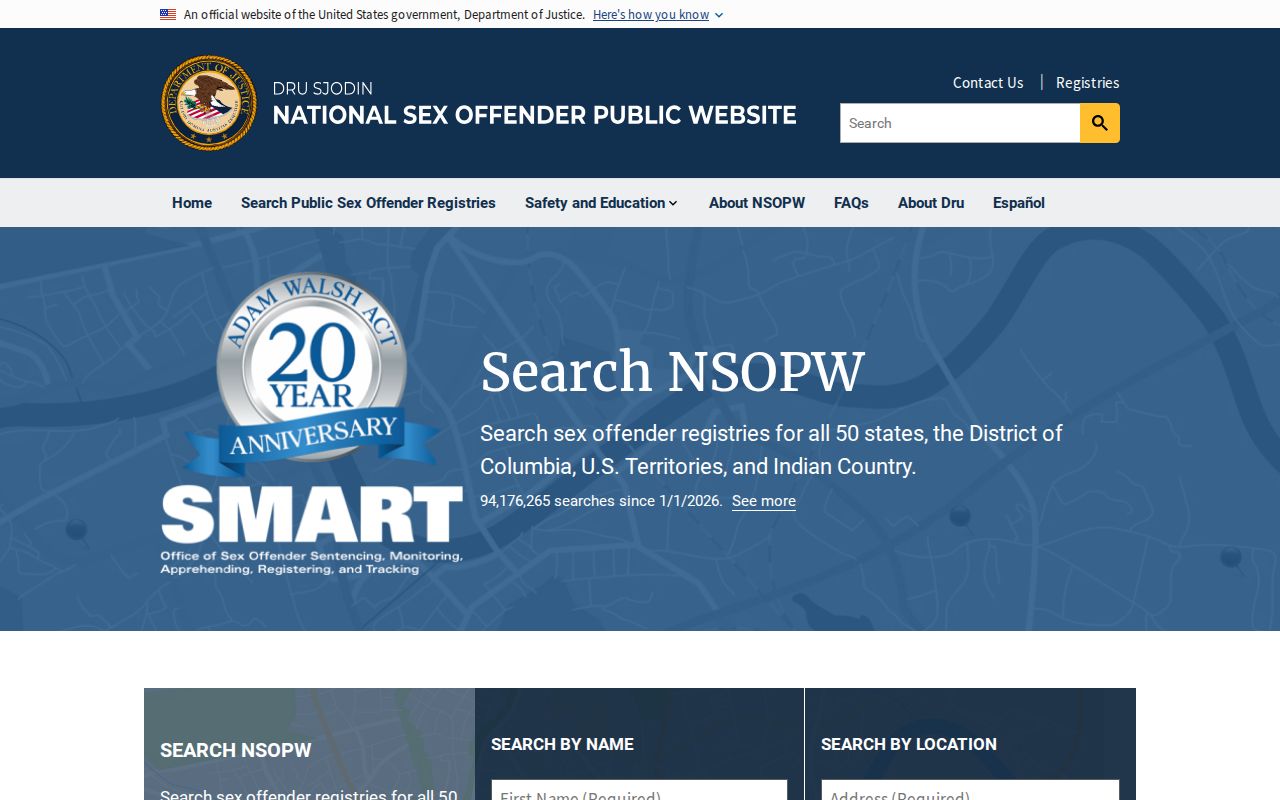
This national layer helps widen a safety search while preserving the need to confirm each result with its listed jurisdiction.
Registration Requirements and Levels in Washington
Washington risk levels describe notification scope. They are not the federal SORNA tiers, and they do not create a simple level-based duration chart. Registration length comes from the underlying offense, status, eligibility rules, and RCW 9A.44.140. Some duties can end after a statutory period and required conditions; others continue unless a court or other lawful authority grants relief. A claim that every Level I case lasts one fixed term would be wrong.
The Washington notification law shows the risk-based public-disclosure framework.
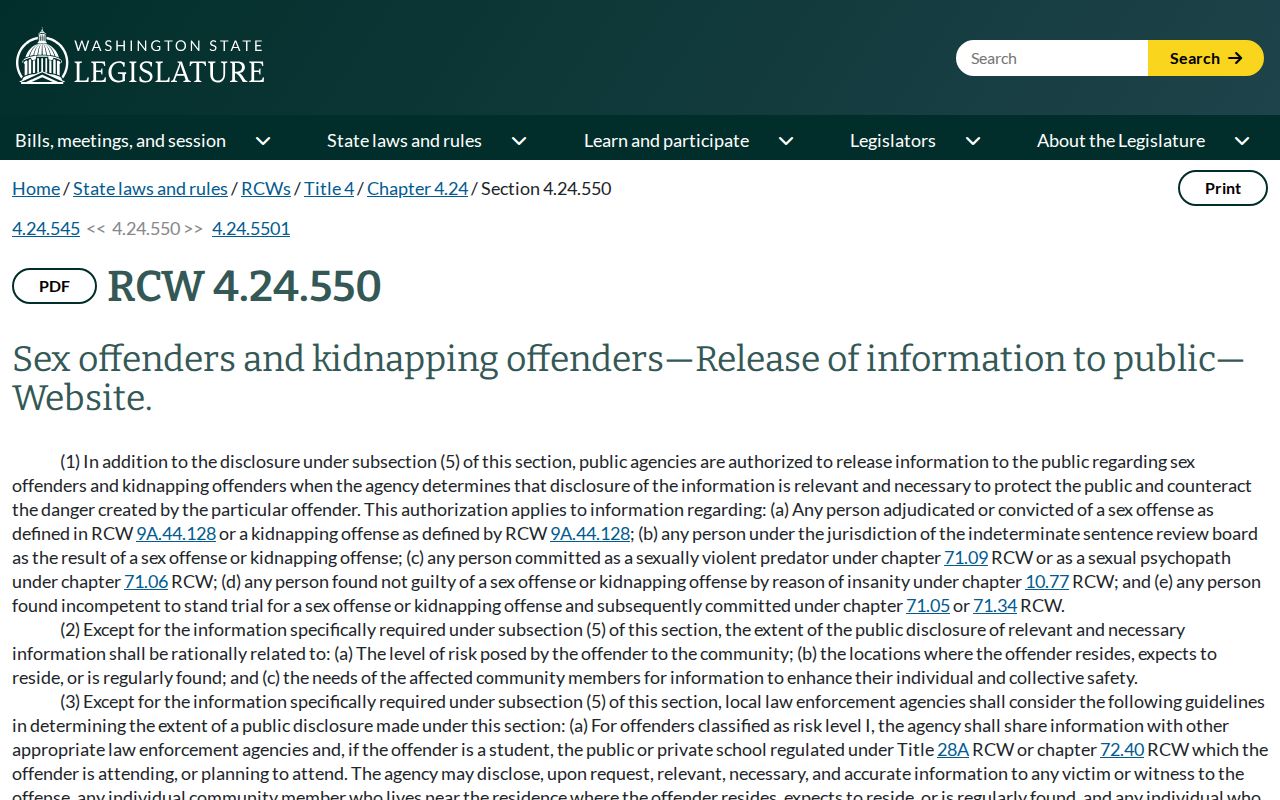
The law image reinforces why public visibility, registration duration, and verification duties must be read as separate questions.
| Risk Level | Public Notification | Duration Relationship |
|---|---|---|
| Level I | Usually limited public release, with notice to specified groups in defined cases | Not fixed by the risk label |
| Level II | Broader notice to relevant groups and community recipients as authorized | Depends on the offense and statutory status |
| Level III | Broad community notice for the highest assessed risk | May continue unless lawful relief applies, but level alone is not the term |
Pierce County Registry Duration Limits
Risk and duration answer different questions. Risk guides how far Pierce County agencies may notify the public. Duration concerns how long the person must register under the offense-based statute and whether relief is available. Federal tier labels should not be pasted onto a Washington record. The public profile may not show enough to calculate an end date, and a searcher should not attempt that calculation from the risk level.
Washington also has no statewide, one-size-fits-all residency distance that can be inferred from a Pierce County map point. A person's supervision terms or a valid local rule may impose conditions, but the registry marker itself does not prove which conditions apply. For an apparent violation, record the public information and contact the responsible agency. Do not approach the home or person.
Pierce County Registry Versus McNeil Island
McNeil Island lies in Pierce County and houses Washington's Special Commitment Center for people civilly committed as sexually violent predators under chapter 71.09 RCW. That system is distinct from criminal registration, Pierce County jail custody, and ordinary Washington Department of Corrections confinement. The center's presence can cause confusion in a local search, yet a civil-commitment record and a public registry profile answer different legal and custodial questions.
A Pierce County registry search should therefore stay focused on the statewide public registry and the sheriff's registration role. Questions about criminal charges and judgments belong with the court. Questions about current county custody belong with the jail roster. Treating McNeil Island as an extra offender-search database would blur those separate systems.
Lawful Use and Community Notification
Registry information exists for public protection, personal safety planning, and lawful community awareness. Pierce County may provide broader notice when Washington's risk framework authorizes it. If an address seems outdated, preserve the public entry and report the concern through law enforcement. Do not publish a claim of noncompliance, threaten anyone, or use the data as a reason for vigilantism. Only the responsible agency can investigate and update status.
Registry misuse can be a crime: Do not harass, threaten, or intimidate anyone; RCW 4.24.550 authorizes good-faith public-protection disclosures, not vigilantism.
For immediate danger, call 911. A nonurgent Pierce County compliance report should go to the sheriff or the local police agency responsible for the address. The registry's own terms remain part of every search.